Char D2 Medium Tank

The Char D2 was a French tank of the interwar period.
In 1930, at a time the Char D1 had not even entered production, the Renault company agreed to build a better armoured version called the Char D2. By using welded armour plate instead of the dated riveted design of the D1 this would be lighter than a simple version of the D1 made with thicker plating. The tank should be able to serve as an alternative in the role of battle tank for the heavy Char B1, should the latter be forbidden by treaty. The failure of the armament limitation talks resulted in a severe reduction of the projected manufacture, now in the form of an interim tank. Organisational difficulties with Renault caused the actual production of a first series of fifty to be delayed to the years 1936 and 1937. A second series of fifty was ordered in 1938, despite indications that the type was mechanically unreliable, as a possible cheaper addition to the expensive Char B1, to be able to raise more armoured divisions of the Infantry Arm. Due to Renault's financial problems, this second, partially improved version, was only realised in early 1940, bringing total production to a hundred.
The three prototypes were, among others, fitted with turrets of theRenault FT 17 during a mock-up. The production models of the first series had the APX-1 turret, armed with a short 47mm SA34 tank gun. The second series used the much more powerful 47mm SA35 tank gun; from March 1940 this was retrofitted to a number of the older vehicles, despite a parallel project to rebuild them as flamethrower tanks.


In 1937 the type equipped one tank battalion, which was considered an elite unit, as part of Charles de Gaulle's regiment. It was well-trained in the use of advanced tactics, including the use of radio-sets. In 1940 the effectiveness of this unit had much diminished, because of the worn-out state of its tanks, aggravated by the decision to raise three autonomous tank companies with the new vehicles, even though insufficient trained crews were available. Nevertheless the Char D2 units fought tenaciously during the Battle of France, losing most of their tanks to mechanical breakdown instead of enemy action.

Development
At the same time the Char D1 was ordered, a plan was made to develop a more modern tank. The Char D1 had already departed from the pure infantry support concept and evolved from a light into a medium tank, capable of fighting enemy armour; this made it the obvious candidate to be quickly changed into a lighter alternative for the Char B1 battle tank, needed because the latter type was in danger of being forbidden by an expected armaments limitation treaty under the auspices of the League of Nations, imposing an upper weight limit of twenty metric tonnes for armoured fighting vehicles.
The Direction de l'Infanterie proposed on 23 January 1930, in a letter to the ministry of defence, to build a better armoured tank, using 40 mm plate, that nevertheless would be swifter at 22 km/h by fitting a 120 hp engine. The weight however should rise only from 14 to 15.5 metric tonnes, made possible by using welded instead of riveted armour plate. On 14 April the plan was approved and in May Louis Renault was contacted, who agreed to develop this type as the Char D2, together with a colonial tank, theChar D3, which would closely resemble its sister project.

To introduce the new welding technique entailed hiring foreign experts, which was very expensive. Renault insisted that the costs would be paid in advance by the French Army, which however had no corresponding budget available. On 8 December 1931 the deadlock was broken by a new agreement: Renault would first build a prototype with a riveted hull, the Renault UZ, which was delivered in April 1932. First the type was tested in Rueil; in May 1933 field tests were carried out by 503e RCC. The type was accepted for production, which decision was affirmed by the Conseil Consultatif de l'Armement on 12 December 1933.
At that moment however, Germany had just left the League of Nations altogether, making the limitation talks irrelevant, from which then France retired also. Existing plans to produce 750 Char D2s, 150 per year for the period 1935-1939, (six hundred to equip twelve battalions and 150 as a matériel reserve) were immediately reduced. On 14 January 1934 the High Command confirmed only the plan of a first production order of fifty. All these decisions were taken on the basis of experience gained with the riveted prototype, though it was well understood that from it no firm conclusions could be drawn on the quality of the intended welded type.
Meanwhile two welded prototypes had been ordered in December 1932. These were finished in August 1933, but only delivered in November. From December 1934 till the summer of 1935 the Commission de Vincennes used the three available prototypes to test different engine configurations. The riveted hull was equipped with a 120 hp petrol engine; the other two with diesel engines. These were rejected in favour of the petrol engine even though its combination with the intended welded hull had not yet been tested.
Nevertheless on 29 December 1934 the order of fifty hulls was granted to Renault, at a price of 410,000 French Francs per piece. The turrets were produced separately. First the ST3 turret (Schneider Tourelle 3) had been tested in 1933; then it was considered to use the ST2, then seen as a possible standard turret for all heavier tanks, but finally a choice was made for theAPX1, originally developed for the Char B1, costing ₣ 200,000 which brought the unit price to ₣ 610,000. The fifty vehicles were only delivered from May 1936.
Due to this delay a planned second order of a hundred, to bring total production to 150, to be made in 1935, was cancelled. It had been assumed that the lighter Char D2 could be quickly produced as an interim type, to speed the formation of the first Infantry armoured division of the Infantry.

Description
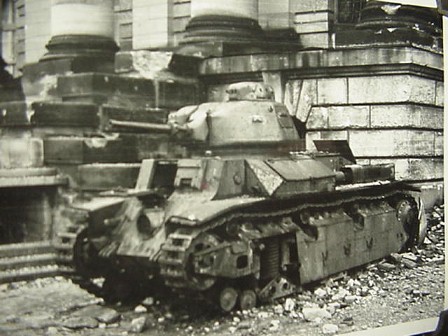
In essence the Char D2 is an improved Char D1. The different turret type used, increases its height somewhat to 266.6 centimetres; the hull is 175.5 centimetres high. The length of the hull, without tail, is 546 centimetres; its width is reduced to 222.3 centimetres through the use of a narrower track, 35 centimetres wide. The suspension is largely identical but the top rollers, to which a tension wheel is added, are placed somewhat higher to prevent track resonance, a persistent problem with the Char D1. The armour plate covering the three vertical coil springs consists of six instead of eight panels; mud-chutes are added below each top roller. There are three bogies per side, each with four road wheels, a coil spring and two shock absorbers. In front, and at the back below the sprocket, there is a tension wheel with its own damper; identical to the road wheels proper they bring the total number of such wheels to fourteen. Another change are the fenders with large stowage bins that give the false impression to be part of the main armour.
The production vehicles use far less welded sections than at first intended. To reduce the price, Renault has opted to implement a novel construction technique, using large flat screws, serving both as bolts and, applied heated, as rivets, attaching the main armour plates to each other by means of thin connecting steel strips. This way no internal girders, forming a real chassis, are needed. The armour plates are 40 mm thick.
Like with the Char D1 there is a crew of three, but the radio-telegraphy operator is sitting to the right of the driver instead of the commander, and the antenna, of the ER52 set, has been moved to a position next to him. To make room a hull machine-gun is absent. This new configuration had been demanded to create a roomier fighting compartment. Two command vehicles, series numbers 2016 and 2049, have a second antenna on the left to serve their ER51 long range set. The engine power has increased considerably to 150 hp by installing a Renault V-6 9.5 litres motor, but as the weight has increased to 19.75 (just below the twenty tonne limit) instead of the intended 15.5 metric tonnes, the gain in maximum speed is limited to 23 km/h. The gear box has four speeds. Four fuel tanks together holding 352 litres allow for a range of a hundred kilometres. The wading capacity is 120 centimetres, a trench of 210 centimetres can be crossed, an obstacle eighty centimetres high or a slope of 50% climbed. The hull has a fixed 7.5 mm machine-gun low in the glacis on the right side.
The commander is the sole occupant of the APX1 turret, acting also as gunner and loader for the 47 mm SA34 gun, which has a limited anti-tank capacity, and the optionally coaxial 7.5 mm Châtellerault machine-gun. The gun could fire two types of ammunition: a HE (High Explosive) called the Obus D with a shell weight of 1250 gramme and a muzzle velocity of 490 m/s; and an APHE (Armoured Piercing High Explosive), the Obus B Modèle 1932, with a shell weight of 1410 gramme, an explosive charge of 142 gramme and a muzzle velocity of 480 m/s. It rendered an armour penetration of just about 25 millimetres at a distance of a hundred metres, barely enough to be effective against light armoured vehicles.

Specifications
Weight19.75 metric tonnes
Length5.46 m
Width2.22 m
Height2.66 m
Crewthree

Armor40 mm
Main
armament
47mm SA34 Gun, later models 47mm SA35 Gun
Secondary
armament
2x 7.5 mm MG
EngineRenault 6-cyl petrol
150 hp
Suspensionvertical springs
Operational
range
100 km
Speed23 km/h

Source : Wikipedia

Black Prince Infantry Tank

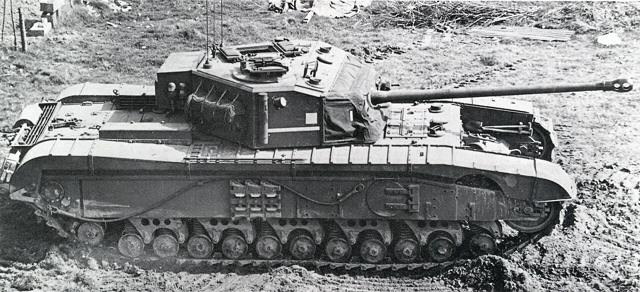
Tank, Infantry, Black Prince (A43) was the name assigned to an experimental development of the Churchill tank with a larger, wider hull and a QF 17-pounder (76 mm) gun. It was named after Edward, the Black Prince, a famous 14th century military leader.


Development
As a development from the Churchill, the Black Prince was a continuation of the line of Infantry tanks, that is slower, heavier tanks intended to operate in close support of infantry. The parallel development in British tank design were the Cruiser tanks, which were intended for more mobile operations. A43 was the General Staff Specification number issued in 1943, for an interim tank that would eventually be superseded by a "Universal tank" that would replace both Infantry and Cruiser tanks.
The cruiser line led to the Cromwell tank (and the 17 pounder-armed Challenger variant) and then the Comet tank, (which had a variant of the 17 pounder gun) entering service during the war. While not as heavily protected as the Churchill, the Comet showed the way tank development was going. This led to the last of the cruiser line and the first of the Universal tanks, the very successful Centurion tank.

A larger gun than a conventional Churchill required a larger turret on a wider turret ring and consequently a widening of the tank hull to carry this. The Black Prince weighed around ten tons more than the Churchill so the suspension was modified and the tracks widened by 10 inches to carry the extra load. However, the Churchill's 350-horsepower (260 kW) engine was retained, leading to the tank's being underpowered and slow, with maximum speeds of 10.5 mph (16.9 km/h) on roads and 7.5 mph (12.1 km/h) cross country. This was so slow that the tank's tactical usefulness would have been limited. Consideration was given to the use of the Rolls-Royce Meteor engine; this would have increased the available power to 600 hp (450 kW), but the idea never left the drawing–board.Likewise, plans to fit the Black Prince with the turret from the Centurion were never carried out.
By the time the Black Prince prototypes had appeared in May 1945, theSherman Firefly had acquired a proven combat record, the Comet tank was in service and the introduction of Centurion was imminent. All these tanks carried the QF 17-pounder or a derivative; all had better mobility than the Black Prince and the Centurion had frontal armour of comparable effectiveness. The Black Prince had become redundant and the project was abandoned.
The Black Prince marked the end of the development of the Churchill tank, and the end of the Infantry tank concept in British tank design.

Specifications
Weight50 long tons (51 t)
Length28 ft 11 in (8.81 m)
Width11 ft 3.5 in (3.442 m)
Height9 ft (2.7 m)
Crew5 (Commander, gunner, loader, driver, co-driver/hull gunner)

Armour152 mm (6.0 in)
Main
armament
QF 17 pdr with 89 rounds
Secondary
armament
2 x 7.92 mm Besa machine guns
EngineBedford Type 120 horizontally opposed 12-cylinder
350 hp (260 kW)
Power/weight7 hp/ton
Suspensionsprung bogie
Operational
range
about 100 mi (160 km)
Speed10.5 mph (16.9 km/h) on road
7.5 mph (12.1 km/h) off road

Source : Wikipedia

Jagdtiger Tank Destroyer

Jagdtiger ("Hunting Tiger") is the common name of a German heavytank destroyer of World War II. The official German designation wasPanzerjäger Tiger Ausf. B as it was based on a lengthened Tiger IIchassis. The ordnance inventory designation was Sd. Kfz. 186. TheJagdtiger was the heaviest armored fighting vehicle operationally used during World War II. The vehicle carried a 128 mm PaK 44 L/55 main gun, capable of out-ranging and defeating any fielded Allied tank. It saw service in small numbers from late 1944 to the end of the war on both the Western and Eastern Front. Tiger ace Otto Carius commanded a company of Jagdtigers. His post-war memoir provides a rare combat history of the Jagdtigers which had been under his command. Although 150 were ordered, only between 77 to 88 were produced. Due to an excessive weight the Jagdtiger was continuously plagued with mechanical problems. Today, three Jagdtigers survive in museums.

Development

With the success of the StuG IIIMarder IMarder II, and Marder III in the tank destroyer role, the military leadership of Nazi Germany decided to use the chassis of existing armored fighting vehicles as the basis for self-propelled guns. German tank destroyers of World War II mostly used fixed casemates instead of moveable turrets to significantly reduce the cost of mounting large caliber guns. 

In early 1942 a request was made by the Army General Staff to mount a 128 mm gun on a self-propelled armored chassis. On 18 May 1942 Adolf Hitlerordered that the 128 mm gun be utilized in the tank destroyer role, rather than for infantry support. Firing tests of the 128 mm gun showed to have a high percentage of hits; lower caliber heavy shells such as the 88 mm and 105 mm were also tested.
By early 1943 a decision was made to install a 128 mm gun on a Panther or Tiger I chassis as a heavy assault gun. The Panther chassis was considered unsuitable after a wooden mockup of the design was constructed. On 20 October 1943 another wooden mockup was constructed on a Tiger II chassis, and presented to Hitler in East Prussia. Two prototypes were produced; a version with the eight road wheel Porsche suspension system (number 305001) and a version with the Henschel nine overlapping wheel suspension system (number 305002),[2] as used on the production Tiger II. They were completed in February 1944. It was originally designated as Jagdpanzer VI, but was later named the Jagdtiger. It received the inventory ordnance number Sd.Kfz.186.


Specifications
Weight71.7 tonnes (158,000 lb)
(Henschel suspension)
Length10.65 m (34 ft 11 in)
including gun
Width3.6 m (11 ft 10 in)
Height2.8 m (9 ft 2 in)
CrewSix

Armor250 mm (9.84 in)
Main
armament
1 × 12.8 cm PaK 44 L/55
Secondary
armament
1 × 7.92 mm Maschinengewehr 34
EngineV-12 Maybach HL 230 P30
700 PS (690 hp, 515 kW)
Power/weight9.76 PS/tonne
Suspensiontorsion bar
Operational
range
Road: 120 km (75 mi)
offroad: 80 km (50 mi)
Speed34 km/h (21 mph)

Source : Wikipedia

Sturmgeschütz III Tank Destroyer

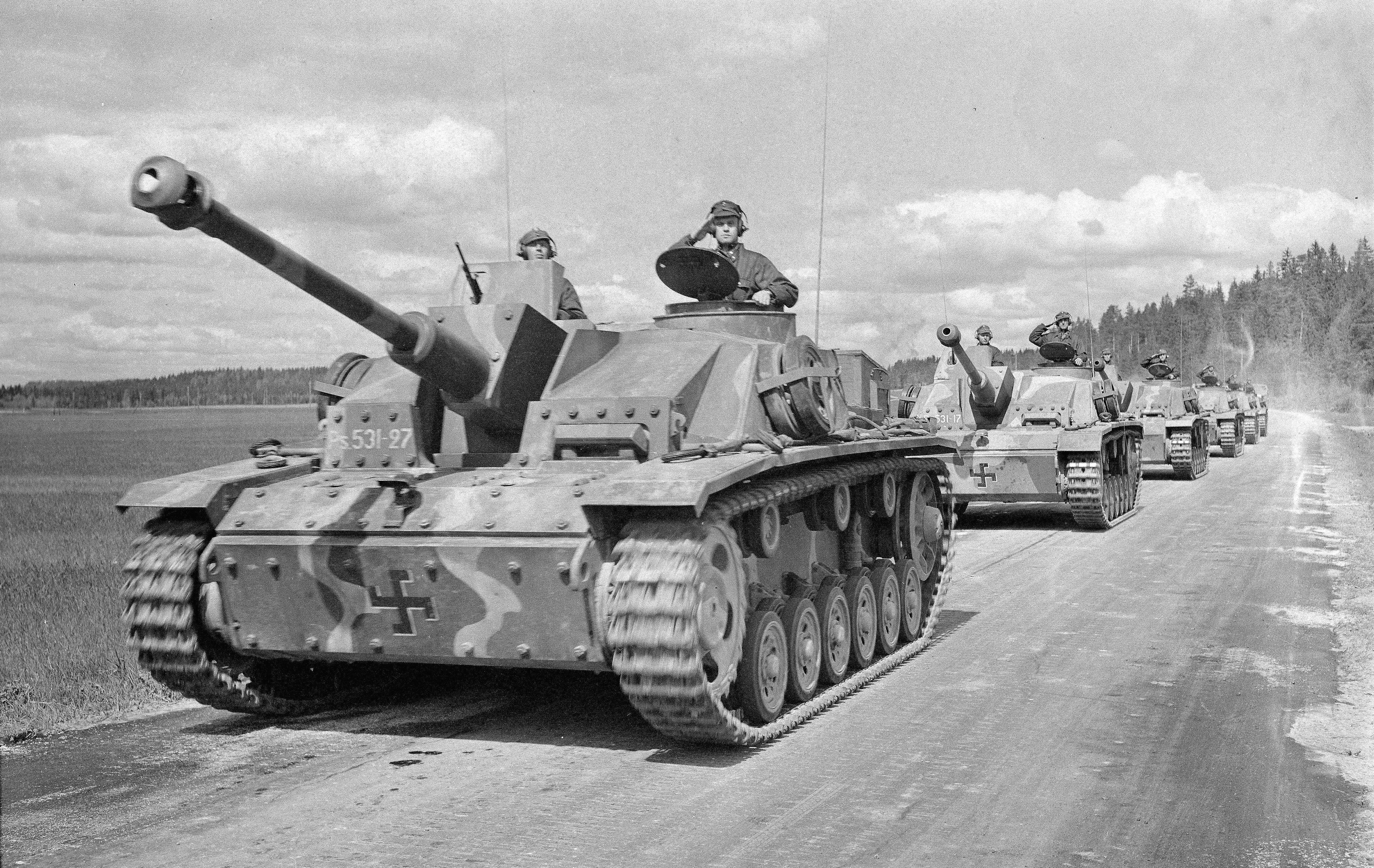
The Sturmgeschütz III (StuG IIIassault gun was Germany's most produced armoured fighting vehicle during World War II. It was built on the chassis of the proven Panzer III tank. Initially intended as a mobile, armoured light gun for infantry support, the StuG was continually modified and was widely employed as a tank destroyer.


Development
The Sturmgeschütz III originated from German experiences in World War I when it was discovered that during the offensives on the western front the infantry lacked the means to effectively engage fortifications. The artillery of the time was heavy and not mobile enough to keep up with the advancing infantry to destroy bunkers, pillboxes, and other minor obstacles with direct fire. Although the problem was well known in the German army, it was General Erich von Manstein who is considSturmartillerie. This is because the initial proposal was from (then) Colonel Erich von Manstein and submitted to GeneralLudwig Beck in 1935, suggesting that Sturmartillerie ("assault artillery") units should be used in a direct-fire support role for infantry divisions. On June 15, 1936, Daimler-Benz AG received an order to develop an armoured infantry support vehicle capable of mounting a 75 mm (2.95 in) artillery piece. The gun mount's fixed, fully integrated casematesuperstructure was to allow a limited traverse of a minimum of 25°
ered the father of the
and provided overhead protection for the crew. The height of the vehicle was not to exceed that of the average man.
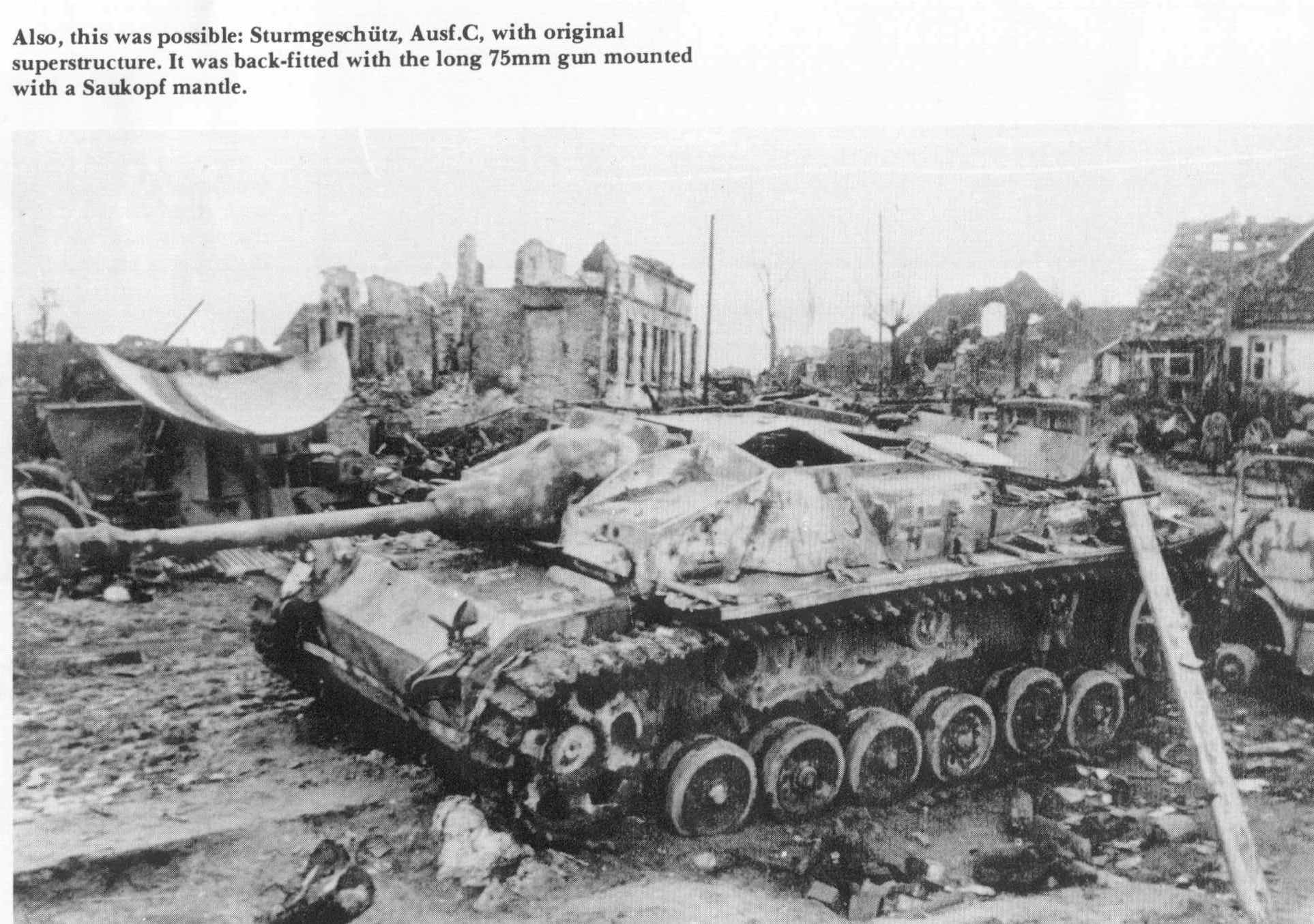
Daimler-Benz AG used the chassis and running gear of its recently designed Panzerkampfwagen III medium tank as a basis for the new vehicle. Prototype manufacture was passed over to Alkett, which produced five prototypes in 1937 on Panzer III Ausf. B chassis. These prototypes featured a mild steel superstructure and Krupp’s short-barreled 75 mm StuK 37 L/24 cannon. Production vehicles with this gun were known as StuG III Ausführung (version) A to E. While the StuG III was considered self-propelled artillery it was not initially clear which arm of theWehrmacht would handle the new weapon. The Panzerarm, the natural user of tracked fighting vehicles, had no resources to spare for the formation of StuG units, and neither did the infantry branch. It was agreed, after a discussion, it would best be employed as part of the artillery arm.
The StuGs were organized into battalions (later renamed "brigades" for disinformation purposes) and followed their own specific doctrine. Infantry support using direct-fire was its intended role. Later there was also a strong emphasis on destroying enemy armour whenever encountered. As the StuG III was designed to fill an infantry close support combat role, early models were fitted with a low-velocity 75 mm StuK 37 L/24 gun to destroy soft-skin targets and fortifications. After the Germans encountered the Soviet KV-1 and T-34tanks, the StuG III was first equipped with a high-velocity 75 mm StuK 40 L/43 main gun (Spring 1942) and in Autumn 1942 with the slightly longer 75 mm StuK 40 L/48 gun. These versions were known as the Sturmgeschütz 40 Ausführung FAusf. F/8and Ausf. G.
When the StuG IV entered production in late 1943 and early 1944, the "III" was added to the name to separate it from the Panzer IV-based assault guns. All previous and following models were thereafter known as Sturmgeschütz III.
Beginning with the StuG III Ausf. G, a 7.92 mm MG34 could be mounted on a shield on top of the superstructure for added anti-infantry protection from December 1942. Some of the F/8 models were retrofitted with a shield as well. Many of the later StuG III Ausf. G models were equipped with an additional coaxial 7.92 mm MG34.
The vehicles of the Sturmgeschütz series were cheaper and faster to build than contemporary German tanks; at 82,500 RM, a StuG III Ausf G was cheaper than a Panzer III Ausf. M, which cost 103,163 RM. This was due to the omission of the turret, which greatly simplified manufacture and allowed the chassis to carry a larger gun than it could otherwise. By the end of the war, ~11,300 StuG IIIs and StuH 42s had been built.

Specifications
Weight23.9 tonnes (52,690 lbs)
Length6.85 m (22 ft 6 in)
Width2.95 m (9 ft 8 in)
Height2.16 m (7 ft 1 in)
Crew4

Armor16 – 80 mm (.62 - 3.15 in)
Main
armament
1x 7.5 cm StuK 40 L/48
54 rounds[2]
Secondary
armament
1x 7.92 mm Maschinengewehr 34
600 rounds
EngineMaybach HL 120 TRM V-12 gasoline engine driving six-speed transmission[3]
300 PS (296 hp, 221 kW)
Power/weight12.6 PS/tonne
Suspensiontorsion bar
Operational
range
155 km (96 mi) (.9 mpg-US (1.1 mpg-imp; 260 L/100 km) at 22 mph (35 km/h), 71 US gal (59 imp gal; 270 l) fuel)[4]
Speed40 km/h (25 mph)

Source : Wikipedia

Jagdpanther Tank Destroyer

The Jagdpanther (German: "hunting panther") was a tank destroyerbuilt by Nazi Germany during World War II based on the chassis of thePanther tank. It entered service late in the war (1944) and saw service on the Eastern and Western fronts. The Jagdpanther combined the very powerful 8.8 cm PaK 43 cannon of the Tiger II and the characteristically excellent armor and suspension of the Panther chassis, although it suffered from the general poor state of German ordnance production, maintenance and training in the later part of the war, which resulted in small production numbers, shortage in spare parts and poor crew readiness. 

Development
The Jagdpanther had been preceded by two attempts at mounting a 8.8 cm gun as a self-propelled anti-tank weapon; Ferdinand using the ninety-one leftover Porsche-built VK4501(P) chassis from the Tiger tankcompetition it had lost to Henschel in 1942, and the Nashorn using aPanzer III/IV chassis. Ferdinand proved to be too heavy and Nashornsmall and underpowered.
A heavy tank destroyer design based on the 8.8 cm Pak 43 gun and the Panther tank chassis was ordered in late 1942 as design SdKfz 173. The prototype by MIAG was demonstrated in October 1943 before Hitler.
Production started in January 1944; in February Hitler specified the simpler Jagdpanther name instead of its original "8.8 cm Pak 43/3 auf Panzerjager Panther".
To accommodate the heavier-calibre gun, much as on previousJagdpanzer-style unturreted tank destroyers, the glacis plate and sloped hull sides of the Jagdpanther were extended up into an integral, turretless fixed casemate as part of the main hull itself to provide a roomy interior. The Jagdpanther had side armour of increased thickness (60 mm) to offset the slightly reduced angle of the side armour necessary to provide enough interior space. Frontal armour was 80mm. The new (April 1944) Panther Ausf. G had the same feature, to harmonize production and increase protection.
It was armed with the same long-barreled 8.8 cm gun as the Tiger II "King Tiger". The gun was mounted in a central mantlet which gave it a limited traverse of 11 degrees to each side. A single 7.92 mm MG-34 machine gun for local defence was in a ball mount right hand side of the front glacis plate. The machine gunner was also the wireless operator. The driver sat on the left. The gunner had a rangefinder and a periscope telescopic sight. The periscope - linked to the gun mount - was under an armoured housing on the roof. The Jagdpanther had a good power-to-weight ratioand a powerful main gun, which enabled it to destroy any type of Allied tank. Based on the existing Panther Ausf G chassis, the vehicle did not suffer too many mechanical problems. It had an upgraded transmission (the ZF AK 7-400 heavy duty) - which had been planned for the Panther II - and final drive to counter the Panther's main weakness. It was manned by a crew of five: a driver, radio-operator, commander, gunner and a loader.
Two main variants can be distinguished, the earlier (1944 model) G1 with a small internally bolted main gun mantlet and a modified Panther A engine deck, and the later (1945 model) G2 with a larger simplified, outside-bolted mantlet and a modified Panther G engine deck, though late G1s also had the larger mantlet. Early Jagdpanthers had two vision openings for the driver, whereas late versions had only one. The main gun originally had a monobloc gun barrel but later versions were equipped with the Pak 43/4 gun with a two-part barrel. The two part barrel was more economical as barrel wear was not even.
Early G1s (to September 1944) were given Zimmerit anti-magnetic mine coating in a distinctive "small-squared" pattern.

Specifications
Weight45.5 tonnes (100,300 lb)
Length9.87 m (32 ft 5 in)
Width3.42 m (11 ft 3 in)
Height2.71 m (8 ft 11 in)
Crew5

Armor80 mm (3.14 in) frontal
100 mm (3.93 in) mantlet
45mm side
40mm rear
Main
armament
1 × 8.8 cm Pak 43/3 or 43/4 L/71
57 rounds
Secondary
armament
1 × 7.92 mm Maschinengewehr 34
600 rounds
EngineMaybach HL230 P30 (V-12 petrol)
700 PS (690 hp, 515 kW)
Power/weight15.4 PS/tonne
Suspensiondual torsion bar
Operational
range
160 km (99 miles)
Speed46 km/h (28.6 mph)

Source : Wikipedia

Hetzer Tank Destroyer

The Jagdpanzer 38(t) (Sd.Kfz. 138/2), later known as Hetzer("chaser"), was a German light tank destroyer of the Second World Warbased on a modified Czechoslovakian Panzer 38(t) chassis. The project was inspired by the Romanian "Mareşal" tank destroyer.
The name Hetzer was at the time not commonly used for this vehicle. It was the designation for a related prototype, the E-10. The Škoda factoryfor a very short period confused the two names in its documentation and the very first unit equipped with the vehicle thus for a few weeks applied the incorrect name until matters were cleared. However, there exists a memorandum from Heinz Guderian to Hitler claiming that an unofficial name, Hetzer, had spontaneously been coined by the troops. Post-war historians basing themselves on this statement made the name popular in their works, the vehicle was never named as such in official documents.

Development
The Jagdpanzer 38(t) was intended to be more cost-effective than the much more ambitious Jagdpanther and Jagdtiger designs of the same period. Using a proven chassis, it avoided the mechanical problems of the larger armoured vehicles.
It was better armored than the thinly armoured earlier PanzerjägerMarder and Nashorn with a sloped armour front plate of 60 mm sloped back at 60 degrees from the vertical (equivalent in protection to about120 mm), carried a reasonably powerful 75mm gun, was mechanically reliable, small and easily concealed. It was also cheap to build.
The Jagdpanzer 38(t) succeeded the open-top Marder III (based on the same chassis) in production from April 1944; about 2584 were built until the end of the war. The older Marder III Panzerjäger series retained the same vertically sided chassis as Panzer 38(t). In the Jagdpanzer 38(t), the lower hull sides slope 15 degrees outward to make roughly hexagonal shape when viewed from front or rear. This increased the available interior space and enabled a fully enclosed casemate-style fighting compartment. Because of the fully enclosed armor, it was 5 tonnes heavier than the Marder III. To compensate for the increased weight, track width was increased from 293 mm to 350 mm.Initial production Jagdpanzer 38(t) did not sit even with the ground because gun, transmission and thicker frontal armor weighed the front down. Leaf springs were strengthened from June 1944 which leveled the posture of the vehicle. From May–July 1944, accessibility was improved in the form of more hatches: commander's smaller hatch opening to the rear, then right rear corner for radiator access, and left rear corner for fuel tank access. From August 1944 lighter inner and outer mantle reduced the weight by 200 kg. These are more conical looking mantle than half cone shaped initial mantles. Also from August 1944, new rear idler wheels were introduced. These had 8, 6, and 4 (not necessarily in that order) lightening holes instead of 12. These simplified the manufacturing process. In September 1944, front 16 spring leaves were increased in thickness to 9mm per leaf, rear 16 leaves maintained 7mm each in thickness. Also in September side Schurtzen's front and rear tips were bent inward to prevent them from catching bushes and get dismounted. It was discovered that driver's periscope housing acted like a shot trap, preventing incoming shells from bouncing off the front glacis. The protruding housing was removed, instead periscope was inserted into vertical cuts to the front armor from October 1944. Also from October 44, flame reducing muffler was introduced. These reduced visibility and backfire. Commander's head cushion was added to the hatch from October 1944. At the same time, road wheel's rims were riveted instead of using bolts. To cope with heavy front, and the necessity to traverse the vehicle to aim, gear ratio was lowered to 1:8 instead of 1:7.33 to reduce the stress on final gears from January 1945. Button-down Jagdpanzer 38(t) was blind to the right side. Since 20mm side armors (same as late model Panzer II's side armor) were only adequate to protect the crew from fairly small caliber guns, it was important to face the threat forward. Hence, commander's field of view was planned to be improved by installing a rotating periscope in Jagdpanzer 38(t)-Starr, just as Sturmgeschutz III and Elefant had evolved from a single pair of periscopes to all around vision blocks. However, Jagdpanzer 38(t)-Starr came too late to see the action in the field.The Jagdpanzer 38(t) equipped the Panzerjägerabteilungen (tank destroyerbattalions) of the infantry divisions, giving them some limited mobile anti-armor capability. After the war Czechoslovakia continued to build the type (versions ST-I and ST-III for training version, about 180 units built) and exported 158 vehicles (version G-13) to Switzerland. Most vehicles in today's collections are of Swiss origin.
By order of Adolf Hitler in November 1944, a number of Jagdpanzer 38(t)s were refurbished straight from the factory with a Keobe flamethrower and accompanying equipment instead of the normal gun. The flame projector, encased in a metal shield reminiscent of that of a gun barrel, was easily prone to damage. Fewer than 50 of these vehicles, designated Flammpanzer 38, were completed before the end of the war, but they were used operationally against Allied forces on the Western Front.
Further variants were a Jagdpanzer 38(t) carrying the 150 mm sIG 33/2 Howitzer, of which 30 were produced before the end of the war, and the Bergepanzer 38(t), a light recovery vehicle of which 170 were produced. Plans were made to produce other variants, including an assault gun version of theJagdpanzer 38(t) carrying a 105 mm StuH 42 main cannon, a version mounting the 7.5 cm KwK 42 L/70 gun from the Panther, and an anti-aircraft variant mounted with a flak turret. The war ended before these proposed models were put into production. Prototypes were also developed for the Jagdpanzer 38(t) Starr, this was a simplified version of the Jagdpanzer 38(t) and also a step towards the E-10. The design removed the recoil absorber from the main 7.5 cm PaK 39 gun, instead attaching the gun to the chassis, and using the Jagdpanzer 38(t)'s bulk and suspension to absorb the recoil. 10 were built, but never issued. 9 converted back to normal Jagdpanzer 38(t) and Hitler ordered the remaining prototype destroyed rather than let it be captured at the end of the war.

Specifications
Weight15.75 tonnes (34,722 lb)
Length6.38 m (20 ft 11 in)
Width2.63 m (8 ft 8 in)
Height2.17 m (7 ft 1 in)
Crew4

Armor8-60 mm (0.31-2.36 in)
Main
armament
1x 7.5 cm PaK 39 L/48
41 rounds
Secondary
armament
1× 7.92 mm Maschinengewehr 34
1,200 rounds
EnginePraga 6-cylinder petrol, 7.8 litres
160 PS (158 hp, 118 kW) at 2,800 rpm
Power/weight10 PS/tonne
Transmission5 + 1 Praga-Wilson Typ CV
Suspensionleaf spring
Ground clearance40 cm (1 ft 4 in)
Fuel capacity320 litres (85 US gal)
Operational
range
177 km (110 mi)
Speed42 km/h (26 mph)


Source : Wikipedia